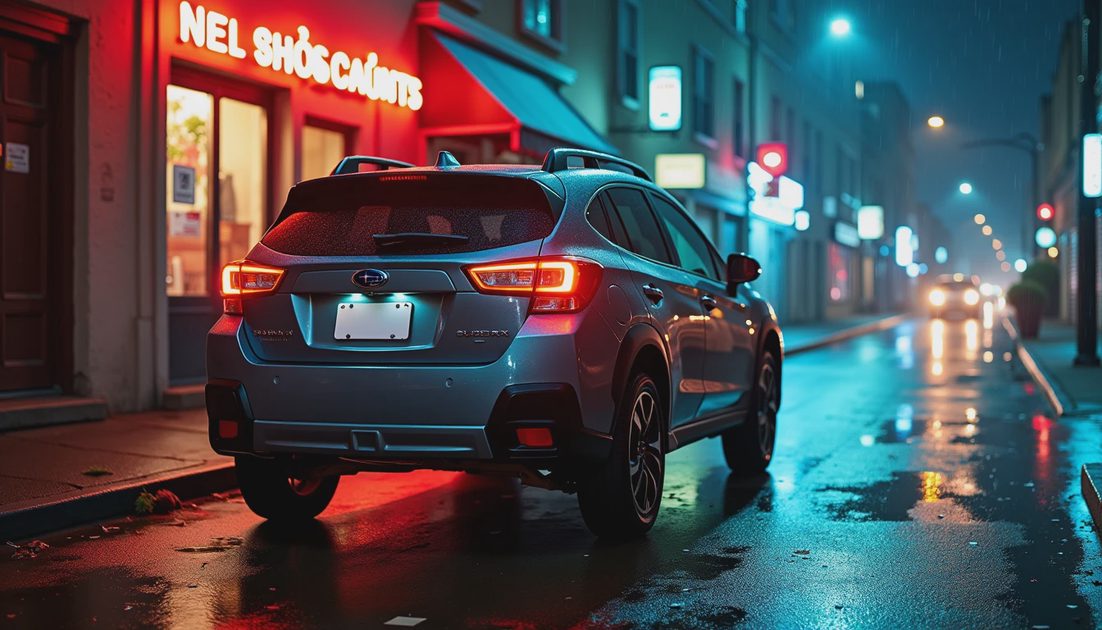
Subaru Crosstrek Takes 6th in 2025 Subcompact SUV Showdown: Competent but Unremarkable
The subcompact crossover has become the default choice for the transition into automotive adulthood. Whether you're cutting ties with the First National Bank of Mom and Dad, relocating for a job across the country, or quietly browsing strollers during your lunch break, this segment offers an affordable entry point with enough utility to justify the investment. We assembled seven models for this comparison, mixing long-time favorites with recently refreshed entries, and drove them through the heart of Detroit and along our 10Best evaluation loop. The goal was to separate the urban runabouts from the suburban haulers, and to find which crossovers truly earn their place in a crowded market. The Subaru Crosstrek, finishing in sixth place, represents a specific philosophy: competence without distinction.
Sitting at a stoplight in downtown Detroit, the Crosstrek announces its presence with a coarse, persistent thrum that vibrates through the cabin even when the tachometer needle barely twitches. It's the auditory signature of a boxer engine working hard to mask the rubber-band sensation of a CVT, a sensory reminder that this crossover occupies a very specific, middle-of-the-road corner of the segment. If this comparison were a classroom, the Crosstrek is the student who sits in the middle, turns in homework on time, but never raises a hand. It isn't the star, nor is it the class clown. It's just there, doing the work with a disarming lack of distinction.
The Bell Curve of Competence
The powertrain is unique in this group, pairing a 182-horsepower 2.5-liter flat-four with a continuously variable automatic transmission. That uniqueness doesn't translate to excitement. The 0-60 mph sprint takes 7.8 seconds, a figure that places it squarely midpack. On the road, the dynamics mirror the acceleration numbers. The CVT avoids the worst lethargy found in some six-speed automatics in this test, offering decent low-speed response, but it never feels engaged. The simulated gear changes are a cosmetic fix that does little to hide the engine drone, which becomes gnarly under load. Even at idle, the Crosstrek was the loudest car of the seven.
Build quality is where the Subaru starts to fray. The doors feel hollow, constructed more of polymer than metal, and that sense of cheapness permeates the interior. The steering wheel is wrapped in a hard, Temu-grade plastic that feels out of place in a modern vehicle. The center console features an unnecessarily large, empty void around the shifter, a design choice that cheapens the architecture rather than adding utility. Technology offers no redemption. The vertical touchscreen is a visual quirk that hides glacial performance. Boot-up times and response rates are among the worst in the group, lagging behind competitors by years. We're looking at interface speeds reminiscent of 2011 hardware, a frustrating contrast to the modern design cues elsewhere in the cabin.
The metrics tell the same story of average performance. Cargo space, quarter-mile times, and braking distances all cluster around the mean. Even the price sits on the tallest part of the bell curve. Our tester rang up at $31,645, a figure that lands right in the money for this class but offers no value proposition to offset the compromises. There are merits, of course. Forward visibility is excellent, making the Crosstrek a confident companion in tight urban environments. The ride quality remains comfortable over broken pavement, and that low-speed CVT response makes stop-and-go traffic manageable. These are the traits of a capable daily driver, but they aren't enough to elevate the Subaru above its rivals.
The comparison highlights how rapidly the segment is moving. The Hyundai Kona illustrates this evolution. Once a twin to the Kia Seltos, the Kona diverged with a 2024 redesign that added significant length. The body grew by approximately half a foot, and the wheelbase extended by a couple of inches. The result is a vehicle that feels vastly more spacious and composed on the road. However, this embiggening came with trade-offs. Despite the dimensional gains, the cargo space did not increase, a reminder that exterior dimensions don't always translate to interior utility. This context is vital when evaluating the Crosstrek; while the Subaru maintains a steady, unchanging presence, rivals like the Kona are actively reshaping their packaging to win over buyers.
The verdict is clear. The Subaru Crosstrek does everything well but nothing exceptionally. It is a no-fuss, appliance-adjacent vehicle for buyers who want transportation without emotional investment. If you need a tool that gets the job done with standard all-weather capability and a comfortable ride, the Crosstrek works. But in a segment where rivals are offering sharper dynamics, better materials, and modern tech, the Subaru's middle-of-the-road nature feels less like a safe choice and more like a missed opportunity.
Verdict
- Pros: Low-speed CVT response, good forward visibility, comfortable ride.
- Cons: Coarse engine note, flimsy panels, slow infotainment.
- Bottom Line: Does everything well but nothing exceptionally. Most of the cars on this list have at least one trait that helps them stand out. The Subaru never rises to the top, but its all-around decent nature may be the kind of no-fuss, appliance-adjacent vehicular experience you're after.