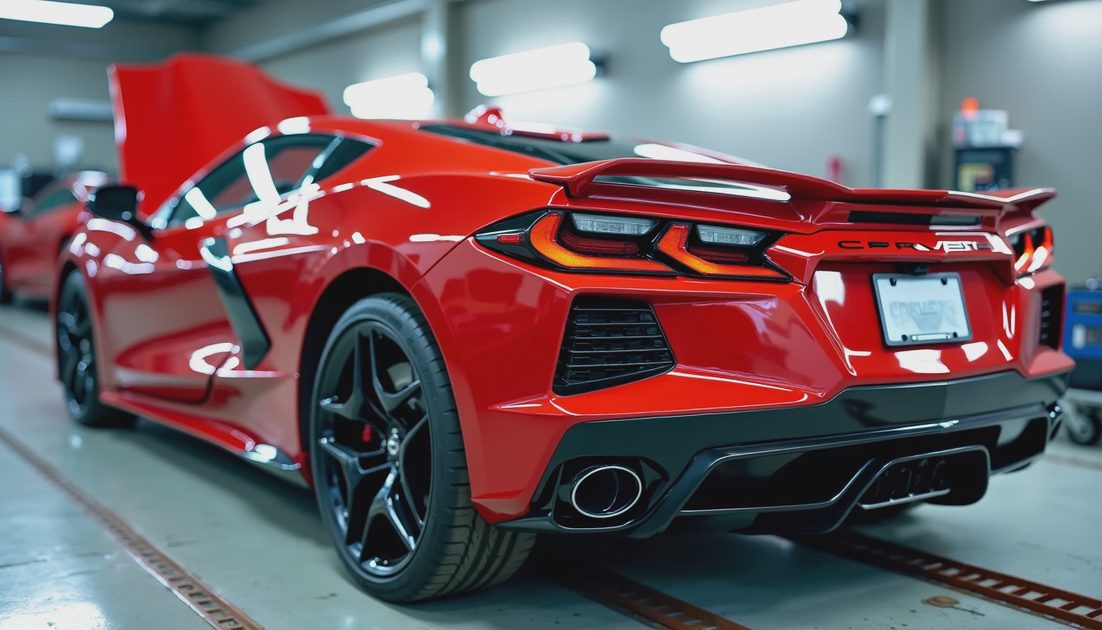
The 2026 Corvette fixes its worst cabin sin—and keeps punching in supercar territory
The moment that sold me wasn’t the stopwatch number. It was the way the C8 Corvette settles mid-corner—nose keyed into the apex, rear planted, steering talking in complete sentences instead of half-truths. That calm, deliberate balance is what happens when a nameplate that spent decades perfecting the front-engine formula finally admits the mid-engine layout was the point all along.
Car and Driver’s 2026 10Best nod isn’t a nostalgic pat on the fender. It’s recognition that the current C8-generation Corvette has matured into a genuine ultra-high-performance sports car—one that doesn’t need a qualification clause about being “good for the money,” even if the pricing still plays that card beautifully. Chevrolet’s decision to abandon tradition and move the engine behind the driver was monumental. The benefits—favorable weight distribution, lower center of gravity, and a low polar moment of inertia—aren’t just engineering trivia here. They show up as real capability, real confidence, and real speed.
And for 2026, the Corvette also does something important that has nothing to do with lateral g: it deletes the much-maligned “great wall of buttons” climate-control arrangement. For a car that’s finally comfortable parking in the same performance neighborhood as exotica, cleaning up a daily-use annoyance matters. A lot.
What owners should know: the C8 is still a two-seat sports car, just a surprisingly usable one
The Corvette remains a strict two-seater—no illusions, no “2+2” marketing gymnastics. Yet even with the engine behind you, it’s described as “mighty spacious,” and it can still handle practical weekend duty, including hauling a set of golf clubs. That’s a very Corvette detail: the car may now be mid-engined and seriously capable, but it still remembers that some buyers want to drive to dinner without packing like they’re boarding a flight.
Body styles remain coupe or convertible. Notably, even the coupe uses a lift-off targa top, so you can get open-air exposure either way without being forced into the full convertible commitment. It’s the kind of flexibility that’s easy to overlook until you live with it.
The bigger story for 2026, though, is that interior rethink. The C8’s button-heavy divider between driver and passenger became a lightning rod, partly because it looked fussy, and partly because it felt like it was trying too hard to be “fighter jet.” Chevrolet has “entirely done away” with that layout for 2026. I’ll reserve judgment on the replacement design until I’ve put real miles on it, but deleting an ergonomic gripe is always a step in the right direction—and it’s the sort of refinement that signals a platform hitting its stride.
Performance, with receipts: Z51 Stingray and E-Ray put numbers on the argument
Here’s what the Corvette does when you stop discussing theory and start measuring pavement.
With the Z51 package, the Stingray coupe is rated at 495 horsepower. In Car and Driver testing, it launch-controls to 60 mph in 2.9 seconds and runs the quarter-mile in 11.4 seconds at 120 mph. That’s not “quick for a $70-something-thousand sports car.” That’s simply quick—full stop.
Then there’s the E-Ray, which changes the conversation by adding traction and hybrid shove. The all-wheel-drive setup uses a 160-hp electric motor up front, along with a wide-body kit “to contain it all.” Total system output is 655 combined horsepower, and the result is violence with polish: 0–60 mph in as little as 2.5 seconds, then a 10.6-second quarter-mile at 128 mph.
Those are serious numbers, and they help explain why the C8 has become the default answer when someone asks, “What supercar should I actually use?” The E-Ray also underlines something important about the modern performance landscape: electrification isn’t automatically about virtue-signaling efficiency. Sometimes it’s just the most effective way to add front-axle torque and make the car leave the line like it was drop-kicked.
Still, any car can be a hero in a straight line if you throw enough horsepower at the problem. What separates the Corvette—per the source material—is that it isn’t defined only by acceleration. Car and Driver calls out direct, accurate steering and “rat-glue grip,” and just as importantly, a refined ride. If you opt for the latest iteration of Magnetic Ride Control, it can be made “even smoother.” That duality—real compliance without diluting response—is exactly what makes a sports car feel expensive, regardless of its badge.
The price-to-performance gap is still the Corvette’s unfair advantage
Car and Driver lists the 2026 Corvette at $71,995–$110,595. Power spans 490–655 hp, and published test results show 0–60 mph in 2.5–3.0 seconds and quarter-mile times of 10.6–11.4 seconds. Top speed is listed at 183–194 mph (manufacturer claim). EPA combined fuel economy is 19 mpg.
That spread tells you a lot. At the low end, the Corvette is still attainable enough to be cross-shopped by buyers who might otherwise land in something far less exotic. At the high end—especially as you climb toward E-Ray money—you’re paying for a level of performance that used to require an Italian last name and a waiting list.
Car and Driver also notes that the Z06, ZR1, and new ZR1X variants push the C8 “even further up Mount Awesome,” but their “required spend” exceeds 10Best limits. In other words: yes, there’s more Corvette above this, and yes, it gets wilder—but this 10Best recognition is focused on the versions that stay within the award’s pricing boundaries.
That’s the Corvette’s enduring magic trick: it doesn’t merely offer speed. It offers access. And for 2026, it sweetens the deal by addressing an interior complaint that never matched the car’s dynamic sophistication.
If you’ve been watching the C8 from the sidelines because you missed the old front-engine identity, this is your reminder to drive one with fresh eyes. The Corvette didn’t just change where the engine sits. It changed what the car can be.