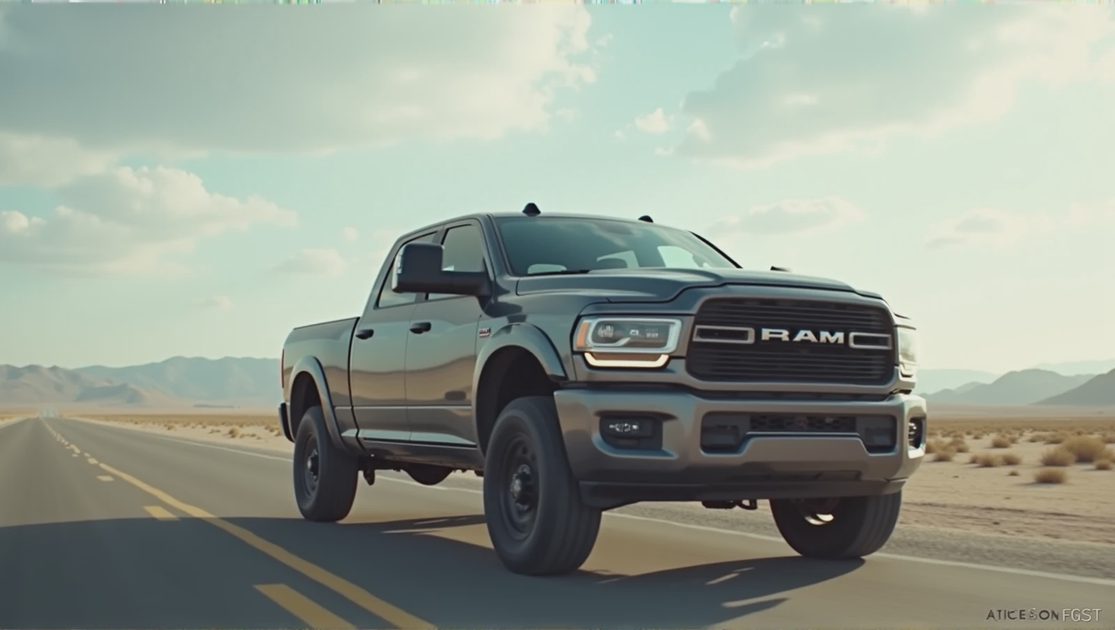
Electric Torque Meets Live Axles: Silverado EV Trail Boss vs. Ram Power Wagon
The rear axle hops violently, shaking the cab as if I'm driving a jackhammer up the hill. Inside the 2025 Ram 2500 Power Wagon, this vibration isn't a warning; it's feedback. It tells you the mechanical locking differentials are doing their job, churning through loose sand where modern traction control systems might hesitate. This is the raw, analog language of off-roading, and it stands in stark contrast to the silent struggle happening in the electric competitor parked at the base of the incline.
The Venn diagram of buyers interested in a windswept electric pickup and a lifted heavy-duty gas-guzzling truck is two distinct circles separated by the distance between Earth and Neptune. Yet, looking at the attributes of the 2026 Chevrolet Silverado EV Trail Boss and the Ram Power Wagon, the overlap is significant. Both hulking beasts measure nearly 20 feet long and weigh between 3.5 and 4.5 tons. They'll each tow 10,000 pounds as a show of strength and, when unloaded, struggle to cover 400 miles on the highway despite the Ram's 31-gallon gas tank and the Chevy's double-decker 205-kWh battery pack. Prices for both start in the mid-$70s and grew to more than $90,000 for the examples we tested at Michigan's Holly Oaks ORV Park.
Analog Grit Versus Digital Precision
The Power Wagon is an off-roading legend that earned its reputation on World War II battlefields, and it's still very much an analog machine with two live axles and two locking differentials. Chevy's Trail Boss badge can claim no such heritage, as it first appeared 10 years ago on a midsize Colorado, but there's no shortage of bravado in that name. The antithesis of Power Wagon, the Silverado EV takes a modern approach to off-roading with immense and infinitely controllable electric torque and four-wheel steering.
If a truck this big and heavy is going to be called Trail Boss, we want to see it boss around the Power Wagon in the dirt. We've already established that these two exist for entirely different types of people. Instead, we set out with a narrower question: Which truck packs more off-road capability? In this battle of old-school grit versus modern technology, we found our answer by staging three battles at Holly Oaks. The first test revealed a startling divergence in how these machines manage power delivery when traction disappears.
The Sandy Hill Reality
We start our competition with what should be an easy, low-stakes test: a hill climb. Our chosen trail isn't all that steep—maybe 20 degrees at its peak—but it's covered in a layer of deep, loose sand. In any rig, getting to the top requires powering through the soft stuff with a bit of momentum and a heavy right foot.
In the Ram, its 405-hp 6.4-liter V-8 snorts and then roars. The crux of the route comes at a hairpin right where the trail is at its steepest and the sand, chewed up by everyone that's come before us, is at its worst. My speed dips, but the engine keeps charging hard, and the 33-inch Goodyear Wrangler Duratracs throw up big rooster tails of grit. The rear axle hops violently, shaking the cab as if I'm driving a jackhammer up the hill, but the Ram keeps on making consistent, confident progress to the top.
Senior features editor Aaron Gold takes the wheel of the Silverado EV. After a false start in the truck's Normal mode, he backs down and selects Terrain mode, a new setting introduced on the Trail Boss that increases the amount of rear-axle steering available and uses the brakes to manage wheelspin and shift torque from side to side. As it approaches the right-hand hairpin, though, the Trail Boss starts losing speed rapidly. Gold has his foot to the floor, but the power gauge indicates the motors are sending just 40 of its maximum 725 horsepower to the wheels. There's no wheelspin or any other indication that the vehicle is attempting to move forward. Gold tries a couple more times with the same result. The Chevy won't make it up this relatively tame hill.
The Bigger Picture
This failure isn't just about one hill; it's about how software interprets danger versus how hardware overcomes it. The Ram relies on mechanical commitment. The Chevy relies on calculation. When the calculation decides the risk outweighs the reward, the electric truck simply quits, protecting its drivetrain but forfeiting the climb. For overlanding purists, that distinction defines the winner before the second test even begins.
Verdict
2025 Ram 2500 Power Wagon
- Pros: Proven mechanical locking differentials, consistent power delivery in low-traction, analog feedback through the chassis.
- Cons: Fuel range limitations, heavy fuel consumption, dated interior technology.
- Bottom Line: An uncompromising tool that trusts the driver to manage the risk.
2026 Chevrolet Silverado EV Trail Boss
- Pros: Immense potential torque, advanced four-wheel steering, innovative Terrain mode software.
- Cons: Conservative power management limits off-road capability, failed basic hill climb test, heavy weight penalty.
- Bottom Line: High-tech prowess hamstrung by protective software limits when the going gets rough.