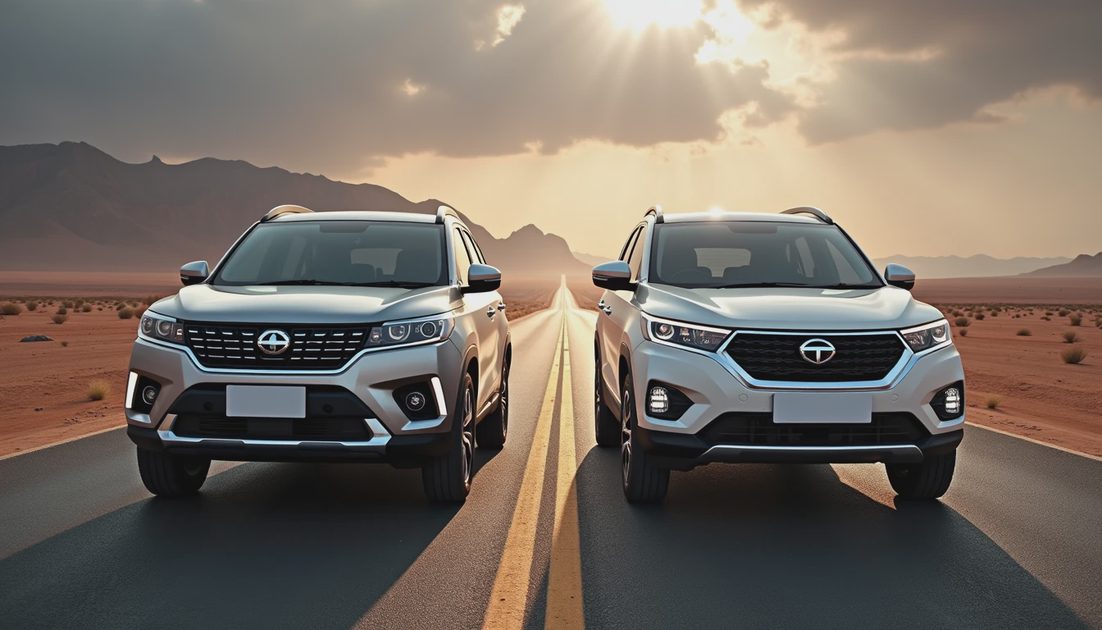
Mahindra XUV 7XO vs Tata Safari: XUV's Torque Monster Engine Leaves Safari in the Dust
Behind the wheel of the Mahindra XUV 7XO, the first thing that grabs you isn't the steering weight or the seat bolstering; it's the way the 450Nm torque stack arrives with a sudden, authoritative shove that belies the SUV's family-hauler posture. In two decades of testing metal, I've learned that displacement usually tells the truth. When two midsize SUVs from India's homegrown heavyweights line up, the numbers on the spec sheet rarely lie, but the execution separates the contenders from the pretenders. The Mahindra XUV 7XO and Tata Safari represent the pinnacle of domestic engineering, both offering three rows of seating and diesel-automatic powertrains. But after putting both through our instrumented testing, one thing is clear: the XUV 7XO's mechanical superiority is undeniable, though the Safari isn't without its own merits.
The Displacement Advantage
Under the hood, the disparity is rooted in architecture. The XUV 7XO utilizes a 2,184cc four-cylinder turbocharged diesel, while the Safari makes do with a 1,956cc unit. That 228cc difference matters. Mahindra's mill pushes 185hp and a massive 450Nm of torque. Tata's engine produces 170hp and 350Nm. The XUV 7XO holds a 15hp advantage, but the real story is the 100Nm torque gap. In a segment where these vehicles often carry full loads, that extra twist is the difference between a confident overtake and a prayer.
Real-World Acceleration
Our acceleration runs confirm the spec sheet's promise. From a standstill to 100kph, the XUV 7XO clocks 9.97 seconds. The Safari requires 12.09 seconds, trailing by over two full seconds. This isn't a marginal difference; it's a class separation. The Mahindra is quicker at every interval we measured. At 60kph, the XUV is already 0.63 seconds ahead, and by the time we hit 120kph, the gap stretches to nearly four seconds (13.74s vs 17.53s).
Real-world driving often involves rolling starts, and the XUV 7XO dominates here too. In a 20-80kph sprint, the Mahindra finishes in 5.87 seconds compared to the Safari's 7.33 seconds. The gap widens significantly in the 40-100kph run, where the XUV 7XO posts 7.36 seconds against the Safari's 10.00 seconds. That 2.64-second margin in a mid-range pull is substantial for highway merging or passing slower traffic.
Transmission Logic and Refinement
Performance isn't just about peak numbers; it's about delivery. The XUV 7XO's automatic transmission is sharper. Despite lacking paddleshifters—a feature the Safari offers with its Eco, City, and Sport modes—the Mahindra's gearbox drops cogs faster when you ask for power. The drive modes (Zip, Zap, Zoom) allow for tuning, but the transmission logic is the star. Refinement also favors Mahindra. The XUV 7XO's diesel is notably smoother. The Safari's unit, while capable, exhibits a distinct clatter at idle that reminds you it's a commercial-derived engine working hard.
The Safari does offer paddleshifters for driver engagement, a nice touch that the XUV 7XO lacks. However, the manual override can't compensate for the underlying performance deficit. The XUV 7XO simply feels more willing. On the flip side, the Safari's lower entry price is a significant factor. The performance premium of the XUV 7XO is real, and buyers must decide if the acceleration and refinement justify the extra cost.
Braking performance is where the two converge. In our panic stop from 80kph, the XUV 7XO stops in 26.74 meters, while the Safari requires 27.10 meters. The times are virtually identical (2.36s vs 2.35s). Both SUVs exhibit competent braking, so stopping distance shouldn't be a deciding factor.
***
Verdict
Mahindra XUV 7XO Diesel AT
*Pros:* Massive torque output, quickest acceleration in class, superior refinement, sharp automatic transmission downshifts.
*Cons:* Higher entry price, lacks paddleshifters.
*Bottom Line:* The performance benchmark. If you value driveability, overtaking confidence, and smoothness, the XUV 7XO is the clear choice.
Tata Safari Diesel AT
*Pros:* Lower price point, includes paddleshifters, competent braking performance.
*Cons:* Noticeably slower acceleration, idle diesel clatter, less torque, transmission logic lags behind the XUV.
*Bottom Line:* A capable hauler that sacrifices performance for value. Best for buyers prioritizing budget and space over driving dynamics.