From behind the wheel of the 2025 Silverado EV Trail Boss, the first thing you notice is the silence. Not the eerie quiet of a typical EV—that’s expected now—but the absence of drivetrain drama as you crawl over a boulder garden. This Trail Boss isn’t just a lifted trim on GM’s electric truck; it’s a deliberate attempt to prove that an EV can do real off-road work. Does it succeed? After a day of pavement, dirt, and rocks, I have clear answers.
The **Silverado EV Trail Boss** splits the difference between the work-focused WT and the luxury-first RST, targeting buyers who want genuine off-road capability without sacrificing the electric advantages. It shares the same Ultium platform, a 205-kWh battery pack, and dual-motor all-wheel drive with the other Silverado EV trims, but the Trail Boss gets a factory 2-inch suspension lift, skid plates, 35-inch all-terrain tires, and underbody protection. On paper, it’s the Ford F-150 Lightning Platinum in mud tires. In practice, it’s a different animal.
Powertrain and Performance
Power comes from two permanent-magnet motors that produce an estimated 754 horsepower and 785 lb-ft of torque in wide-open throttle mode. That’s enough to push the 8,800-pound truck from 0-60 in about 4.2 seconds—gut-check quick for something this heavy. The claimed EPA range is 410 miles on the standard wheel/tire combo, but the Trail Boss’s knobby 35s drop that to an estimated 350 miles. Still, that beats every other electric truck on the market except the base Silverado WT. During my drive, I observed about 1.8 miles per kWh on mixed roads, which translates to roughly 370 miles real-world if you keep the tires at full pressure.
But the real party trick is the Midgate—a pass-through that extends the 5-foot-11 bed to 10 feet 10 inches with the rear seats folded. You can carry 4x8 plywood sheets flat with the tailgate closed. No other EV pickup offers that flexibility. The Trail Boss adds front and rear e-lockers, a standard 4-wheel-steering system that reduces the turning circle to 42.5 feet (SUV-like), and an adaptive air suspension with up to 11.5 inches of ground clearance in off-road mode.
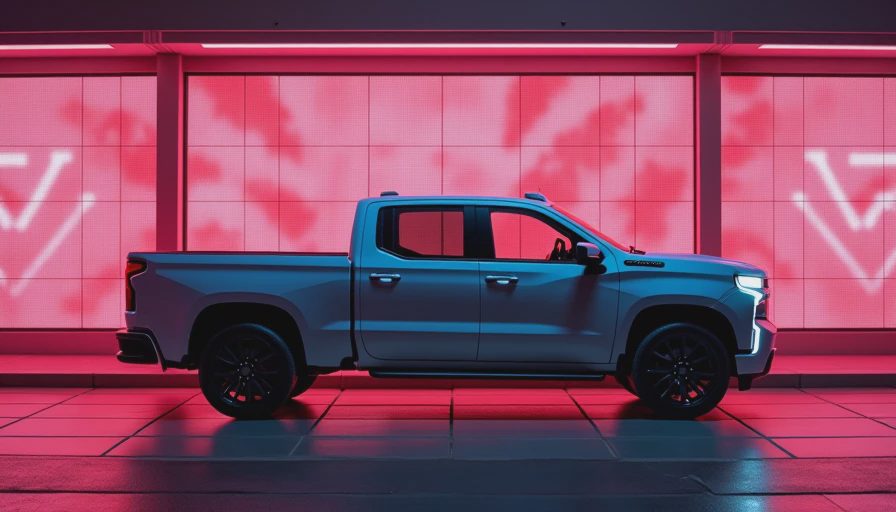
Off-Road Capability
I spent a handful of hours on a rocky trail outside of Lake Arrowhead, and the Trail Boss handled everything without drama. The independent front and rear suspension (a necessity for the flat battery floor) does a fine job absorbing sharp impacts, though you still feel the unsprung weight of the massive tires. The front e-locker is the hero feature—it kept the truck climbing loose, uphill sections where a lifted Jeep might have spun a tire. The 4-wheel-steering helps a ton on tight switchbacks; you can essentially pivot around a tree rather than doing a three-point turn.
Downsides: The approach angle (31 degrees) and departure angle (28 degrees) are good for a full-size pickup, but a dedicated off-roader like the Rivian R1T (34/29 degrees) has an edge. Also, the underbody protection is robust, but the battery pack’s low mounting—even with the lift—means you’re always aware of the skid plates. You won’t be rock-crawling on Rubicon, but for overlanding and fire roads, the Trail Boss is more than adequate.
Interior and Tech
Inside, the Trail Boss gets a 17-inch portrait-oriented infotainment screen, an 11-inch digital gauge cluster, and a head-up display. Materials are durable and easy to clean; the rubberized floor mats and water-repellent seats are ideal for muddy boots. The front seats are comfortable for long stints, but the rear seat cushion is a bit flat and short on thigh support. Rear passengers get ample legroom, though the fixed glass roof (no sunshade) can make the cabin feel like a greenhouse in direct sun.
Chevy’s Super Cruise hands-free driver assist is optional and works well on mapped highways, but it’s not available off-road—not a surprise. The infotainment system is responsive, and wireless Apple CarPlay and Android Auto are standard. One annoyance: the climate controls are buried in the touchscreen, requiring multiple taps to adjust fan speed. Physical buttons for core functions would be better.

Pricing and Value
Pricing for the 2025 Silverado EV Trail Boss starts at $94,195 including destination. That’s a substantial premium over the base WT ($74,800) but undercutting the RST First Edition ($106,195). The Trail Boss qualifies for the $7,500 federal tax credit if purchased (not leased) and if you stay under the MSRP cap—something to double-check with your dealer. Consider the competition: The Ford F-150 Lightning Platinum starts at $97,745 with a 320-mile range and no factory e-locker or 4-wheel-steering. The Rivian R1T Adventure Dual Motor starts at $82,900 but has a smaller battery and less towing capacity (7,700 lbs vs. 10,000 lbs for the Trail Boss). The Trail Boss’s price is high, but the combination of range, capability, and midgate versatility is unique.
The Verdict
**Pros:** Class-leading EV range, genuine off-road hardware, flexible Midgate, dash-rattling acceleration, Super Cruise available.
**Cons:** Very expensive, interior has some cost-cutting (plastic trim, no physical climate controls), air suspension can be floaty on highway, rear seat comfort could be better.
**Bottom Line:** The Silverado EV Trail Boss is the most genuinely off-road-capable electric pickup you can buy today, and its 350-mile range on big tires sets a new standard. If you need an EV work truck that can also play on the trails, this is the one. But for casual off-roaders, the cheaper Lightning or Rivian may be better value.
**Score:** 8/10
*Tested: Silverado EV Trail Boss 4WT (pre-production prototype). Vehicle provided by GM for evaluation.*