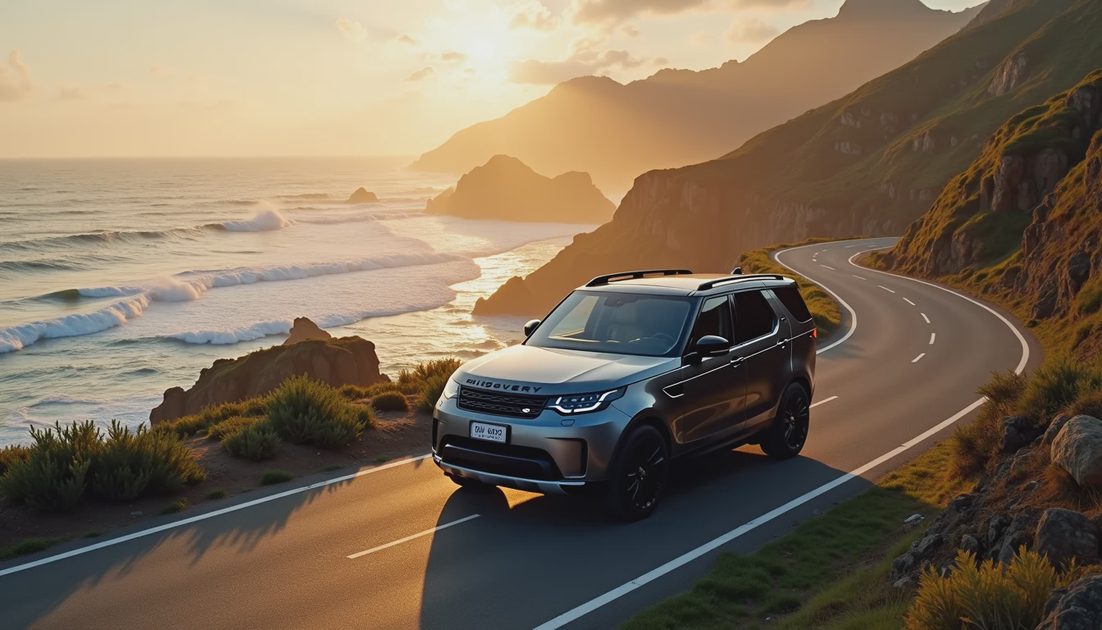
2026 Land Rover Discovery Review: A 5,600-Pound Comfort Couch with a Throttle Identity Crisis
The right foot hovers over the accelerator in the 2026 Land Rover Discovery Gemini, and you quickly learn that moderation is a myth; the pedal offers two distinct personalities, a lethargic crawl or a sudden, lunging surge that leaves you wondering if you've accidentally engaged a launch control mode.
The Discovery has been chugging along in this body style for nearly a decade. The last refresh arrived when social distancing was the headline, a lifetime in automotive years. Competitors have sharpened their claws since then, embracing sharper dynamics and updated platforms. For 2026, Land Rover introduces the Gemini and Tempest trims, sitting atop the four-tier lineup. These are the gatekeepers to the potent 3.0-liter turbocharged inline-six, producing 355 horsepower and 369 pound-feet of torque with 48-volt hybrid assist. The base models make do with a 296-hp turbo four.
The Inline-Six Is Mandatory
The Gemini crossed our scales at a substantial 5,671 pounds. You want the inline-six. The four-cylinder might shed a few hundred pounds, but it won't lose 1,000. All variants get four-wheel drive and an eight-speed automatic. At the test track, the Gemini sprinted to 60 mph in 6.6 seconds. It's decent, but context matters. That's 0.4 second slower than the last Lexus GX we tested and 0.7 second behind the Audi Q7. The Q7 was 540 pounds lighter on our scales; the GX carries about one human less.
The powertrain lacks immediate responsiveness, evidenced by a 7.3-second 5-to-60 mph run. The delta between standing and rolling starts was a tenth worse than both rivals. On the road, the behavior is the real story. The throttle mapping is missing a sweet spot. Light pressure in first gear leaves you pokier than traffic flow demands. Push it a few microns further, and the engine catapults you forward, sending the tachometer toward low earth orbit. The workaround requires unnatural discipline: gentle throttle application through first gear, then slowly dialing in torque after the transmission shifts to second.
Brakes Shine, Throttle Stumbles
The brake pedal doesn't suffer from this ambiguity. Modulation is excellent for smooth stops. From 70 mph, the Discovery halted in 164 feet, beating the Lexus GX by eight feet and the Audi Q7 by 11 feet. That is a genuine bright spot in a segment where heavy SUVs often struggle to shed speed.
Handling isn't the Discovery's forte. It exhibits a wallow during lateral maneuvers. However, the 285/40R-22 Pirelli Scorpion Zero All Season tires helped it record a 300-foot skidpad result of 0.82 g. That trails the Q7's 0.86 g but leaves the discombobulated GX's 0.75 g in the dust. In steady-state cruising, the air springs deliver a smooth, comfortable ride that clearly prioritizes family comfort. The third row, however, remains a tight squeeze; adults will not find a pleasant stay there for long.
Comfort Over Cornering
On the highway, fuel economy is so-so. Our 75-mph test returned 22 mpg, one mpg below the EPA estimate. This edges out the boxier GX, which returned 21 mpg. NVH is a weak point. At 70 mph, the cabin registers 67 decibels, making it louder than the GX by one dB and the Q7 by two.
The Discovery sits in a crowded segment where rivals offer more precision. The Discovery leans into its heritage, promising to "rove all sorts of lands," and the capability is there. The interior materials remain a highlight, offering that distinct Land Rover ambiance that justifies the premium. Yet, the age of the platform is undeniable. The wheelbase and packaging haven't evolved to match the spatial efficiency of newer rivals, which explains the compromise in the third row. It is a fine family rover, provided you master the throttle foot and accept that this is a vehicle built for cruising, not carving.
Pros: Strong inline-six engine, excellent braking performance, comfortable air-spring ride, quality interior materials, genuine off-road capability.
Cons: Bizarre throttle mapping, wallowy handling, loud cabin at speed, tight third row, heavy weight, aging platform dynamics.
Bottom Line: The 2026 Discovery remains a capable, comfortable hauler with genuine off-road chops, but its age is showing in the powertrain tuning and dynamics. The new top trims bring necessary power to haul the heft, though you'll need to master a delicate throttle foot to avoid unwanted lurches. It's a fine family rover, just don't ask it to dance.