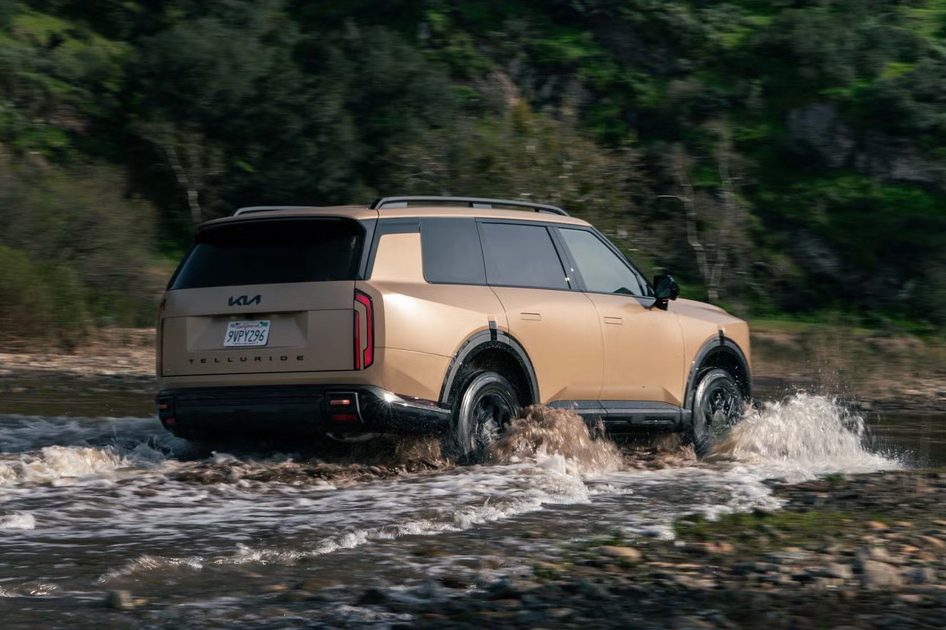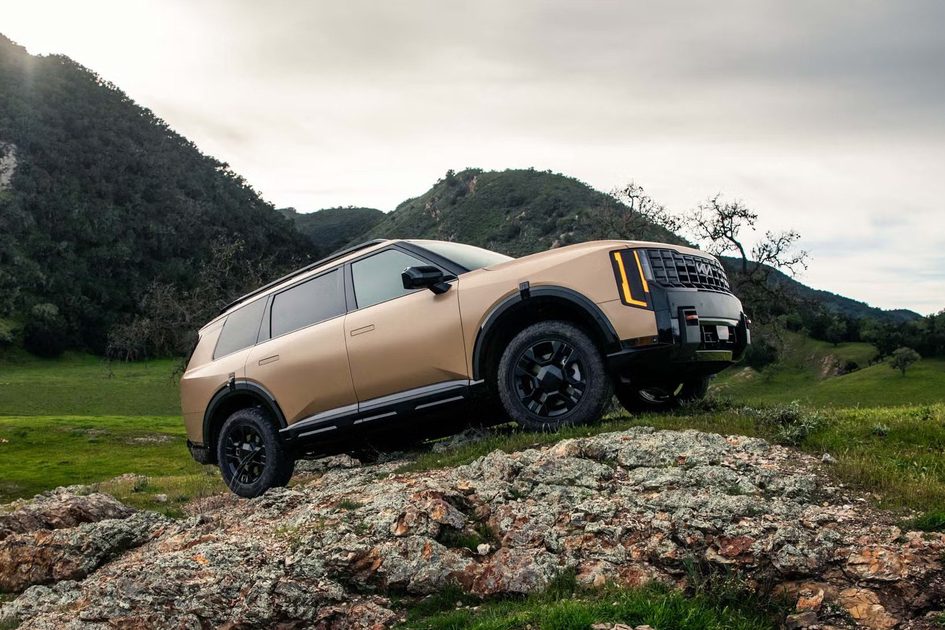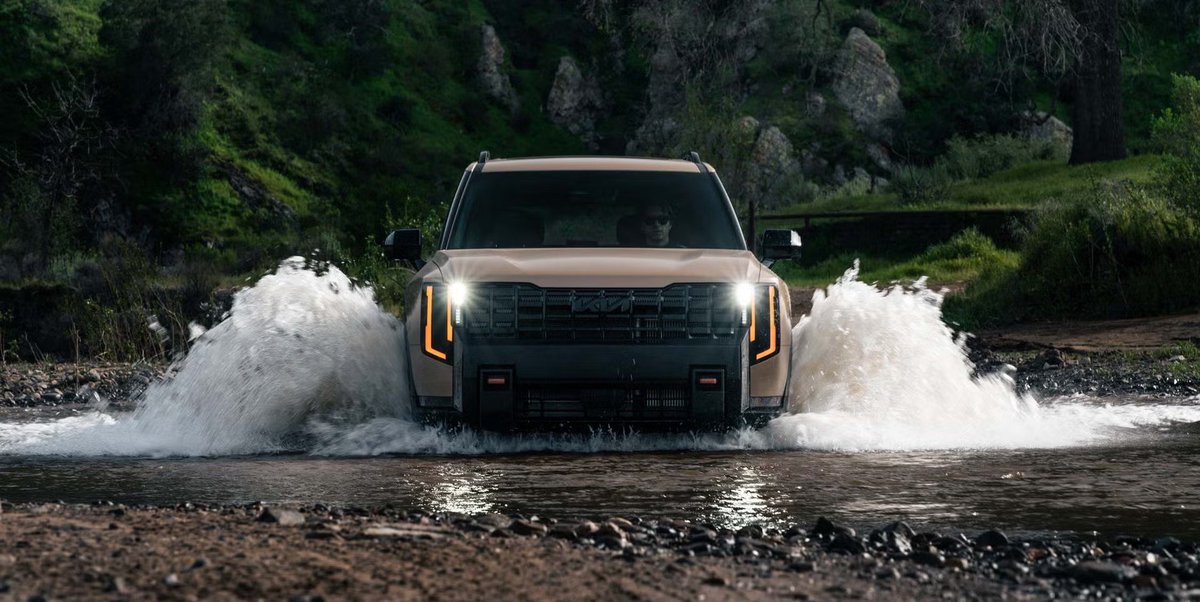
Most Telluride owners will never take their SUVs off the pavement — but that hasn't stopped Kia from engineering the X-Pro to better tackle creek crossings and sandy climbs.
A unibody, three-row family SUV will never be the first choice for serious trail work. Smaller, lighter body-on-frame four-wheel-drivers are always preferable for rock crawling and rough terrain. Even so, the demand for more capable family haulers is real, and virtually every three-row mid-sizer on the market now offers some sort of rugged trim or off-road package.
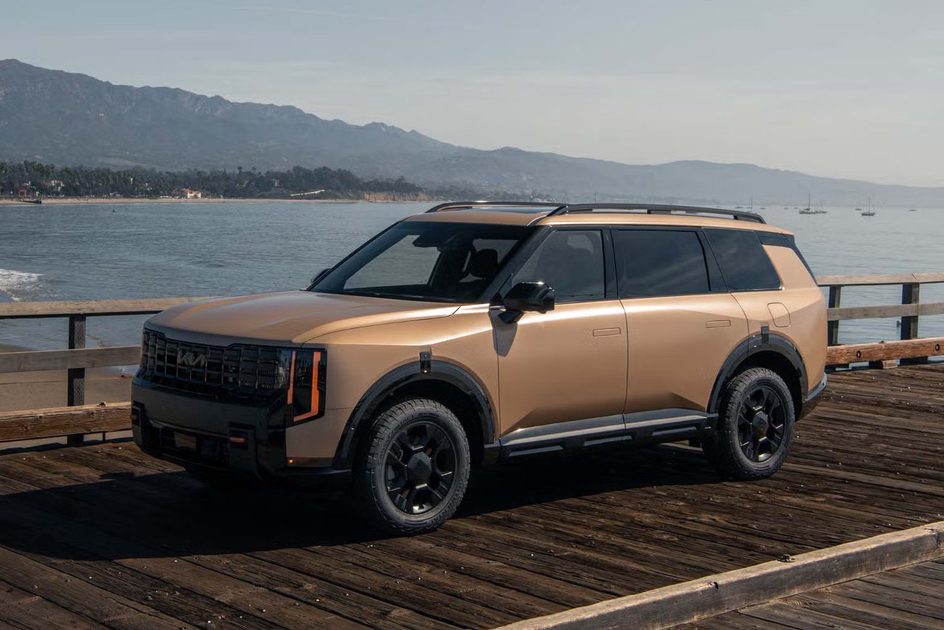
The 2027 Kia Telluride is the latest to join the party, bringing the X-Pro into this new generation with targeted mechanical upgrades for improved capability on dirt and loose surfaces. I recently spent time with the X-Pro on a purpose-built off-road course in Southern California that Kia arranged to demonstrate the SUV's ground clearance, all-wheel-drive system, and various terrain modes. Here's my assessment.
The most significant mechanical upgrade in the X-Pro is a suspension lift that raises ground clearance to 9.1 inches, compared with 7.4 inches on the standard Telluride. That additional height means fewer obstacles to worry about scraping the underbody when things get uneven.
The X-Pro is available in two versions — SX X-Pro and SX Prestige X-Pro — and sits at the upper end of the Telluride hierarchy. All-wheel drive is standard, and the X-Pro pairs exclusively with the non-hybrid 274-hp turbocharged 2.5-liter four-cylinder. Other Telluride trims, including the Hybrid, can be fitted with an X-Line appearance package, but that's just cosmetics — the X-Pro's mechanical upgrades don't carry over.
The X-Pro rides on 18-inch wheels wrapped in exclusive Continental CrossContact all-terrain tires. This gives it considerably more sidewall than other Tellurides, which generally come with 20- or 21-inch wheels and lower-profile rubber. Even the base LX uses 18-inch wheels, but with narrower 235-series all-season tires versus the beefier 255-series rubber on the X-Pro.
Those all-terrain tires also provide better grip on slippery surfaces thanks to a more aggressive tread pattern and compound tuned for off-road use. My time on pavement was brief, but road noise wasn't noticeably elevated.
I found the X-Pro's ride quality over rough terrain genuinely impressive — gravel, ruts, and uneven surfaces are absorbed smoothly, and the interior remains notably quiet.
Available terrain modes include Snow, Sand, and Mud; I used Mud almost exclusively while working through the off-road course. Kia's electronically controlled limited-slip differential was at work, though I noticed it indirectly — the Telluride climbed slippery inclines without drama and powered through an articulation course that had one front and one rear wheel fully lifted.
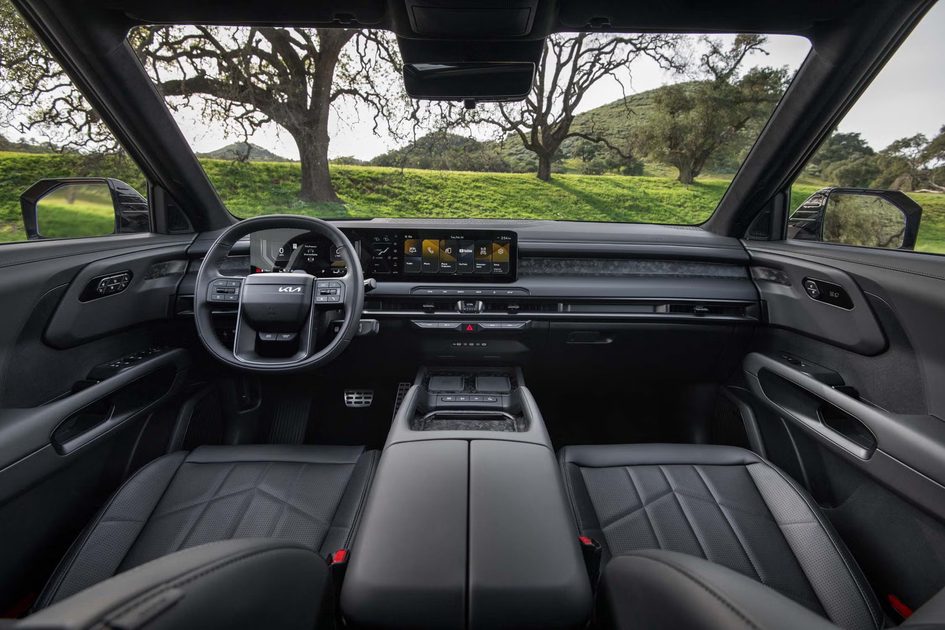
The X-Pro's interior gets some dedicated trim touches, including faux-carbon-fiber dashboard accents and faux-suede seat upholstery, and is available in a distinct set of color combinations.
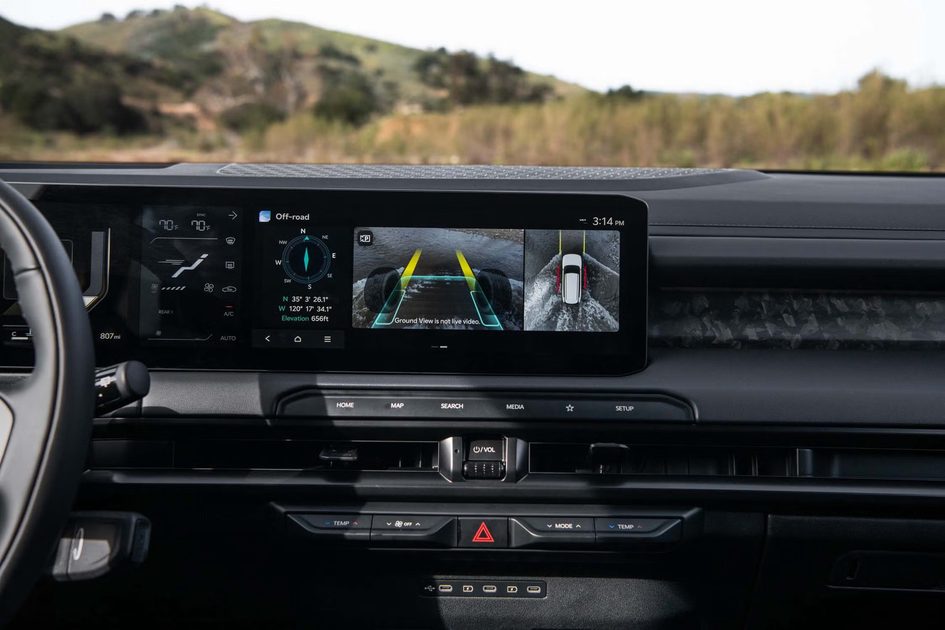
The Ground View Monitor offers helpful camera angles for navigating uncertain terrain ahead, though it only operates below 6 mph, which limits how practical it actually is in the moment.
The infotainment system also provides dedicated off-road gauges displaying steering angle, elevation, and degrees of pitch and roll.
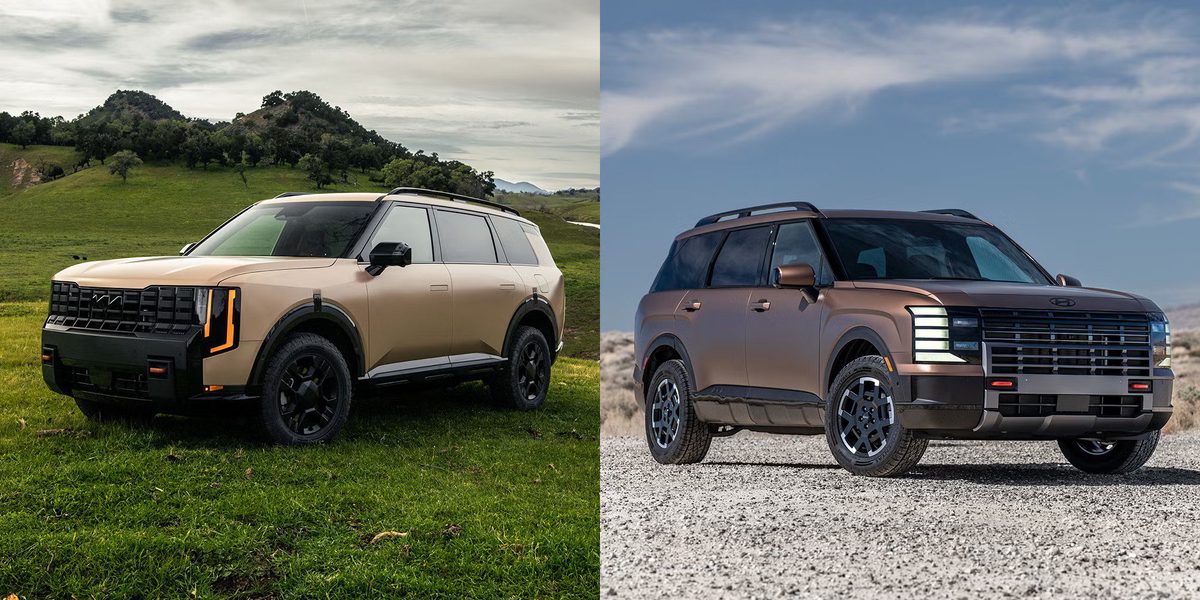
It's worth noting that the Hyundai Palisade — which shares significant mechanicals with the Telluride — has its own off-road variant called the XRT Pro. The primary powertrain difference is that the Telluride uses a turbocharged four-cylinder while the Palisade relies on a naturally aspirated V-6. We haven't instrumented the Telluride X-Pro yet, but our previous testing of non-off-road Tellurides showed it to be quicker to 60 mph than the Palisade.
Most X-Pro buyers will spend the vast majority of their time on public roads, and that's fine. The X-Pro's off-road credentials are broadly comparable to rivals like the Nissan Pathfinder Rock Creek, the Ford Explorer Tremor, and the Chevrolet Traverse Z71. What sets it apart is that it builds those capabilities onto a fundamentally stronger base. Even if the Telluride X-Pro won't conquer significantly harder terrain than its competitors, it's simply a more enjoyable vehicle overall — better to look at, more satisfying to drive, and more comfortable to spend extended time in than those alternatives.