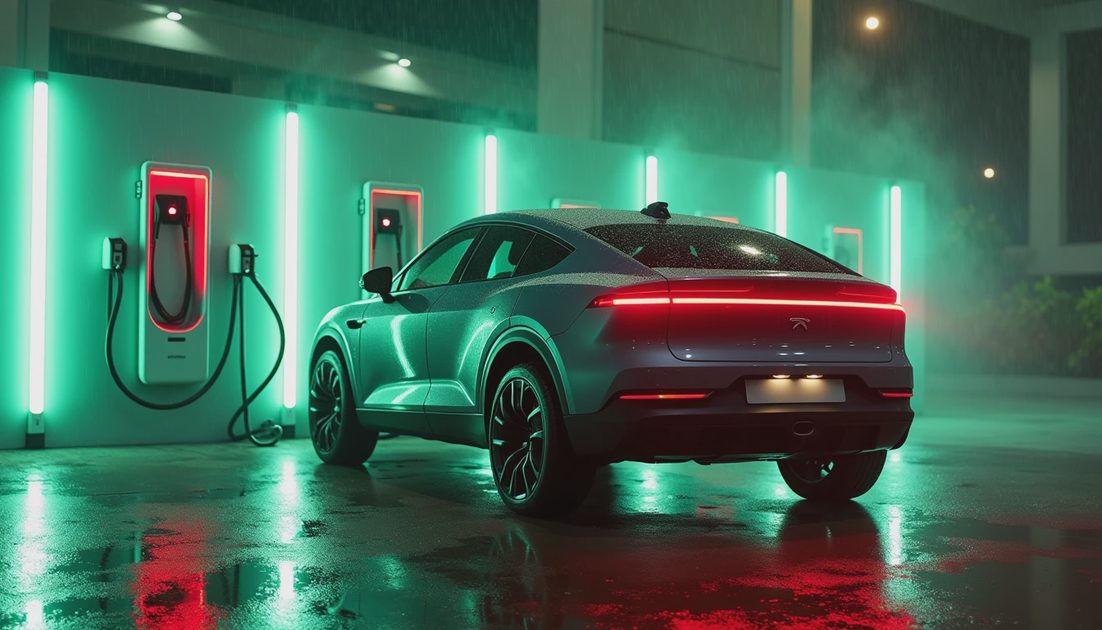
2026 Polestar 4 ditches the rear window—and proves the gimmick isn’t the point
The first time you check the mirror in the Polestar 4, your brain does a double-take: there’s no glass back there, just a bright little TV showing the road you swear should be visible through a rear window. It’s the kind of moment that feels futuristic—right up until the camera gets peppered with grime and you remember why hatchbacks traditionally come with a wiper.
Polestar wants its glassless tail to read as a revolution, but the truth is more mundane. Box trucks, RVs, and buses have leaned on rear cameras for years. The Polestar 4 simply makes the trick a styling statement, swapping the rear window for a roof-mounted camera feeding a digital rearview mirror. The system’s party trick is that it will pan the video feed left or right when you signal a lane change, widening the view between thick C-pillars in a way a small piece of glass can’t.
Clever? Sure. Flawless? Not even close. The camera doesn’t melt snow off itself and it doesn’t clean itself when road grime builds up—problems you don’t have with an actual rear window and, say, a wiper. For a vehicle that’s otherwise so rational, it’s an odd place to plant a flag.
And yet, if you can stop staring at the mirror long enough to look at the car, the Polestar 4’s real headline is sitting right in front of you: this thing is gorgeous.
The slim, coupe-like profile makes a Tesla Model Y look like a product of a different decade. Better still, Polestar found one genuine packaging win in the glass-delete: rear-seat headroom. Fastback SUVs often pinch space back there in the name of silhouette, but the Polestar’s design leaves the rear cabin notably accommodating.
A camera out back, a touchscreen problem up front
Inside, the Polestar 4 aims for elegant minimalism, and largely gets there—until you need to do something basic. Want to manually turn on the headlights? You’ll be picking your way through the 15.4-inch touchscreen, then confirming the choice via a steering-wheel button. That’s not “clean design.” That’s needless friction.
It’s a shame, because the cabin’s overall vibe suits the car’s mission: modern, calm, and quietly premium without beating you over the head with theater. The Polestar 4’s problem isn’t that it’s too weird; it’s that it’s weird in the wrong places. A digital rearview solution you’ll adapt to over time is one thing. Burying fundamental controls is another.
The rear camera concept also has a mismatch between promise and daily reality. In clean weather, the wide view is legitimately useful, and the lane-change panning is a smart touch. But when conditions turn ugly—snow, road spray, general winter filth—the system is only as good as the lens. When that lens is compromised, you don’t just lose some clarity; you lose your rear visibility entirely. That’s a bigger deal than a smeared window.
It’s quick enough to embarrass pricier EVs
The Polestar 4’s performance, though, is no gimmick. The Long Range Dual Motor setup uses permanent-magnet synchronous AC motors front and rear, rated at 268 hp and 253 lb-ft each, for a combined 536 hp and 506 lb-ft. With all-wheel drive and direct-drive transmissions, it rips to 60 mph in 3.2 seconds.
Just as impressive is the way it does it. At 70 mph, Car and Driver measured a hushed 21 sones—quick and quiet in the way modern EVs should be. In those terms, the Polestar isn’t merely competitive; it’s confidently positioned. Car and Driver notes it’s quicker and quieter than Porsche’s Macan 4 EV, which is the sort of comparison that gets enthusiasts’ attention.
The chassis hardware reads like a serious effort rather than a styling exercise: control arms up front, multilink in the rear, and substantial brakes (15.4-inch vented discs front, 14.3-inch vented discs rear). The test car wore Michelin Primacy All Season tires in 255/45R-21 size. At 5216 pounds, it’s no featherweight, but the car’s mission is premium daily speed, not track-day minimalism.
Range and charging: fine, not fearsome
The battery is a liquid-cooled 94-kWh lithium-ion pack. EPA range is 280 miles, and peak DC fast-charging is 200 kW (with 11.0 kW on AC). In a market that increasingly treats range and charging like bragging rights, those figures land as competent rather than class-leading—exactly how Car and Driver describes them.
That matters because the Polestar 4 is trying to win on design, refinement, and price positioning. If you’re cross-shopping in the premium EV space, “only average” range and charging won’t necessarily be deal-breakers, but they do remove one easy justification for choosing it over an alternative that better fits your charging routine.
Where the Polestar claws back ground is value. The 2026 Polestar 4 Long Range Dual Motor carries a base price of $64,300, with the tested example at $71,600. Car and Driver’s takeaway is telling: it costs less than its rivals yet delivers better straight-line performance, a wonderfully smooth ride, and a roomy back seat. That’s the real story. The rear camera grabs your attention; the rest of the vehicle earns your respect.
Over time, that’s also how the Polestar 4 settles into your life. Like early photography—Polestar’s own metaphor—the first experience is slightly uncomfortable because it forces you to process the world differently, at least the part behind you. Then the novelty fades, and you’re left with a comfortable, quick EV that’s less radical than the styling suggests.
Which, frankly, is a compliment. The Polestar 4 doesn’t need to be revolutionary. It needs to be good. And by the numbers—and by the way it delivers speed, quiet, and space—it mostly is.
┌──────────────────────── Verdict ────────────────────────┐
│ Pros: Quick and quiet; spacious back seat; razor-sharp looks. │
│ Cons: Finicky infotainment; EPA range and 200-kW DC charging │
│ are only average; rear camera suffers in bad weather. │
│ Bottom Line: The rear-window delete is the hook, but the real │
│ appeal is a fast, refined EV that undercuts rivals│
│ on price—more rational than theatrical. │
└──────────────────────────────────────────────────────────┘